Today in History: Franco declared leader of the Nationalist government of Spain, 1936 (Spain)
But like the Second Republic before it, the new government could do little to quell the growing divide between left- and right-leaning factions. When elections that were held in February 1936 led to a shift in power to the left, Spain slipped further into chaos. For his part, Franco was once again marginalized, with a new posting to the Canary Islands. Though Franco accepted what amounted to banishment with the professionalism for which he was known, other high-ranking members of the military began to discuss a coup.
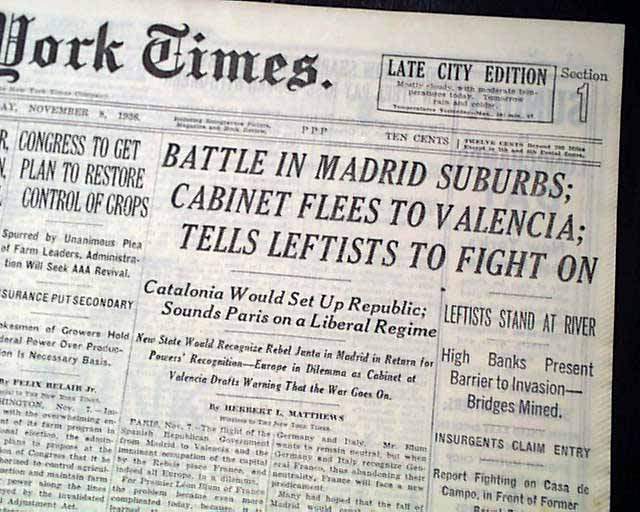
Though he initially kept his distance from the plot, on July 18, 1936, Franco announced the Nationalist manifesto in a broadcast from the Canary Islands as the uprising began in the northwest of Spain. The next day, he flew to Morocco to take control of the troops, and shortly thereafter gained the support of both Nazi Germany and Fascist Italy, whose planes were used to shuttle Franco and his forces to Spain. Establishing his base of operations in Seville the following month, Franco began his military campaign, advancing north toward the seat of the Republican government in Madrid. Anticipating a swift victory, on October 1, 1936, the Nationalist forces declared Franco head of the government and commander-in-chief of the armed forces. However, when their initial assault on Madrid was repelled, the military coup evolved into the protracted conflict known as the Spanish Civil War.
Over the next three years, the Nationalist forces—led by Franco and backed by right-wing militias, the Catholic Church. Germany and Italy—battled the left-wing Republicans, who received aid from the Soviet Union as well as brigades of foreign volunteers. Though the Republicans were able to resist the Nationalist advance for a time, with far-superior military strength, Franco and his forces were able to systematically defeat them, eliminating their opposition region by region.
By the end of 1937, Franco had conquered the Basque lands and the Asturias and had also combined the fascist and monarchist political parties to form his Falange Española Tradicionalista while dissolving all others. In January 1939, the Republican stronghold of Barcelona fell to the Nationalists, followed two months later by Madrid. On April 1, 1939, after receiving an unconditional surrender, Franco announced the end of the Spanish Civil War. Sources vary, but many estimate the number of casualties resulting from the war as high as 500,000, with perhaps as many as 200,000 the result of executions perpetrated by Franco and his forces.


Comments
Post a Comment